All Commercial Services
The full commercial scope across office, retail, industrial, community and parking property.
Commercial pressure washing →A customer forms an opinion about a business before the door opens. The walkway they cross, the entrance mat area, the glass, the awning and whatever is stuck to the concrete in front of the door all get read as a signal about what is inside. Storefront pressure washing is the maintenance of that first impression, plus the parts nobody sees that cause real problems: grease at the back of the building, the dumpster pad and the service area.
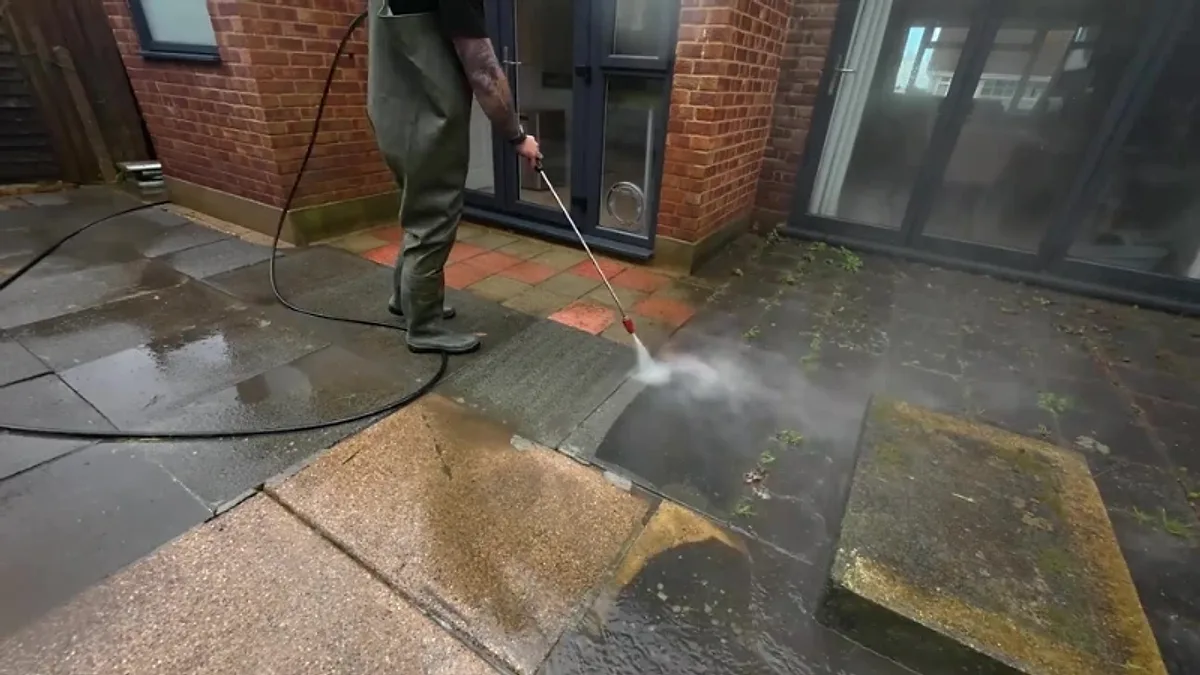
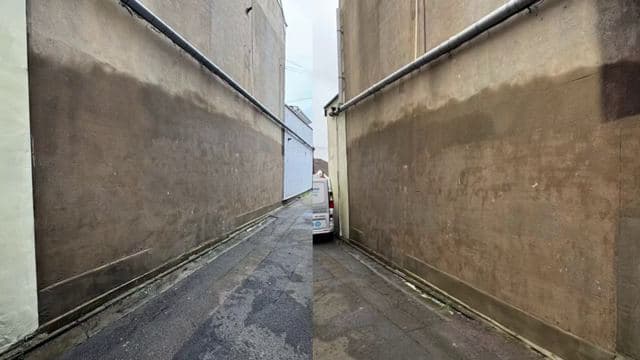
Jacksonville Cleaning Pros cleans retail storefronts, restaurants and quick-service locations, shopping centers and strip plazas, convenience stores and fuel sites, and multi-tenant commercial buildings across Jacksonville and the First Coast. The work is scheduled around your business hours, usually before opening or after close, so nothing happens in front of a paying customer.
Call (904) 938-8585 for a quote, or ask about a recurring schedule for your location.
The apron in front of a storefront takes the heaviest foot traffic on the property and shows it in a specific pattern: a darkened traffic lane, black spots where gum has been ground in, drink rings, coffee and soda spills, and a gray film of general soiling that builds slowly enough that the operator stops seeing it.
Cleaning it properly means a rotary surface cleaner for the open concrete so the finish is even, hand detailing along the building line, at thresholds and around bollards and planters, and a separate pass for gum. Gum does not come off with pressure alone at a sensible distance. It needs heat or a targeted treatment, then removal, and it is quoted by the piece or by the area depending on how bad the frontage is. Oil drips and rust bleed along the building line are a different chemistry again and are covered on rust, oil and stain removal.
This is the part of a food-service property that generates complaints, odor and pest activity, and it is the part most cleaning quotes quietly leave out.
Grease work needs the wash water contained rather than allowed to run to the nearest drain, because the material being removed is exactly what stormwater rules are written about. The containment approach is explained on parking lot and garage cleaning, and it applies here at a smaller scale.
Storefront facades in this climate collect mildew on shaded elevations, dust and road film along frontages on busy corridors, and organic growth under awnings and canopies where the surface stays damp. Painted, stucco, EIFS, brick and metal panel facades are soft washed with detergent and low pressure. Fabric and vinyl awnings are cleaned with a low-pressure method and a mild solution, and they are checked first, because an awning that is already degraded will fail during cleaning rather than because of it.
Signage surrounds, canopy underside and soffit are usually included because they are in the customer's eyeline and they are where organic growth is most visible against a light color. Glass and frames are handled as window cleaning, commonly scheduled on the same visit so the frontage is finished in one go.
For a landlord or center manager the job is different from a single storefront. The whole frontage has to look consistent, because one filthy tenant apron makes the entire center read as neglected. Typical scope covers the full covered walkway, the common entrances, all tenant aprons to a uniform standard, the dumpster enclosures, and the rear service road.
Center work is normally set up as a recurring scope so it can sit in the common area maintenance budget as a predictable line item rather than an unpredictable call-out, and so individual tenants stop arranging their own inconsistent cleaning. Where a center also needs the parking surface handled, that is scoped separately: see parking lot and garage cleaning.
Fuel sites concentrate the worst version of every retail problem in a small area. Pump island concrete carries fuel drips and vehicle fluids, the canopy underside collects exhaust film and organic growth, the entrance takes constant traffic, and the bin area sits close to the building. These sites are usually cleaned overnight or in the early morning, worked in sections so pumps stay in service, and always with wash water contained given what is on the surface.
Nothing about this work should happen while customers are on site. Standard options:
Wet concrete is a slip risk and hoses across a walkway are a trip risk, so the work area is signed and coned while the crew is there, and left clear and dry before the doors open.
High humidity and heavy summer rain keep covered walkways and shaded frontages damp enough for organic growth to establish, and canopy overhangs that protect customers from rain also keep the sun off the concrete. Frontages on high-traffic corridors pick up road film continuously. Locations near the beaches carry airborne salt residue on glass, frames and painted surfaces.
Most retail frontages in this market need the entrance and walkway on a monthly or quarterly cycle, the facade annually, and dumpster pads on the shortest cycle of anything on the property. A single annual clean on a busy frontage is visible as neglect for about nine months of the year.
Call us or send a message — we will give you a straight answer, whether or not it leads to a booking.
Call NowNo. Retail and restaurant work is scheduled before opening, after close or overnight. The only requirement is access to the areas being cleaned and to a water source, both confirmed in advance.
Yes, but not with pressure alone at a distance that is safe for the concrete. Gum needs heat or a targeted treatment and then removal, which is a separate line on the quote from the general surface clean. On a frontage that has never had it done, this is usually the single most visible improvement.
Entrances and walkways on a monthly or quarterly cycle for most locations, more often for food service and anywhere with heavy evening trade. Facades annually. Dumpster pads and service areas on the shortest cycle on the property, because grease compounds rather than sitting still.
Both, and the back of the building is usually where the real problem is. Grease work uses hot water and a degreaser with the runoff contained, which is a different method from the frontage clean.
Not with the correct method. Awnings are cleaned at low pressure with a mild solution and are inspected first, because fabric that is already brittle or seams that have started to fail will not survive any cleaning, ours included. If an awning is at that stage, we will tell you before starting rather than after.
Yes, and it usually should be. A single scope covering all tenant frontage to one standard is cheaper per foot than tenants arranging their own, and it removes the inconsistency that makes a center look poorly run.
We cover all of Jacksonville and Duval County, from the historic districts to the beaches. If your neighborhood is not listed, it is still worth asking.
Not sure if we reach you? Get in touch and we will tell you straight away.
Other property types in the commercial scope, each with its own operational detail.
The full commercial scope across office, retail, industrial, community and parking property.
Commercial pressure washing →Bid by board or CAM manager on annual contracts — an entirely different sales motion from a one-off wash.
HOA & Property Management →Recurring, high-volume contract work with its own operational language that no other page can hold naturally.
Apartment & Multi-Family →Send the address and what needs attention. Quotes are per location, with a recurring option if you would rather it never gets to the point where you notice it. If your portfolio runs beyond retail, the full range of commercial exterior cleaning covers the other property types. Call (904) 938-8585 or contact us.
Call Now