Roof Cleaning
Soft wash treatment for the black streaking on shingle, tile and metal roofs. No pressure on the roof surface at any point.
Roof cleaning →When exterior surfaces are too high, difficult to access, or impractical to reach with conventional equipment, drone pressure washing in Jacksonville, FL provides another way to clean them. Drone-based exterior cleaning can be used for appropriate roofs, building facades, elevated surfaces, and other hard-to-reach areas while reducing the need for conventional high-access setups.
The right cleaning method depends on the surface, its condition, the height and configuration of the property, and the type of buildup present. Some surfaces require pressure washing, while others are better suited to soft washing or another low-pressure cleaning approach.
If you have an elevated or difficult-to-access exterior that needs cleaning, request an assessment to determine whether drone pressure washing is appropriate for your property.
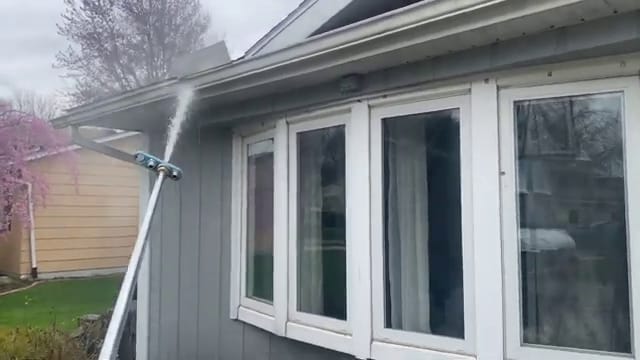
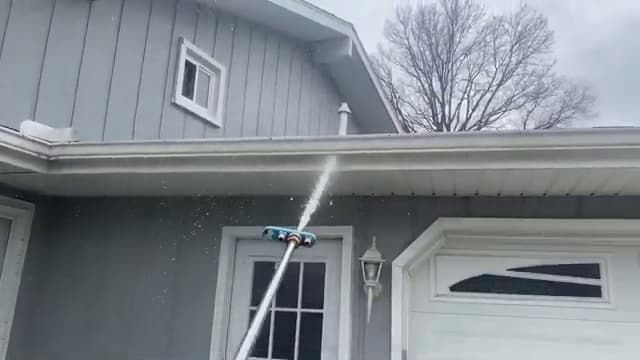
Drone pressure washing uses a purpose-built cleaning drone to deliver water or an appropriate cleaning solution to elevated exterior surfaces from the air.
Unlike a conventional pressure-washing wand operated from the ground, the cleaning equipment is carried or positioned by the drone so the spray can reach areas that may otherwise require ladders, lifts, scaffolding, or other elevated-access methods.
The drone is not simply taking photographs while someone cleans the building manually. In a purpose-built cleaning operation, the aircraft is part of the cleaning system itself.
Depending on the surface and project requirements, drone-based cleaning can involve:
The appropriate method should always be selected according to the material and condition of the surface rather than simply applying the highest available pressure.
The biggest advantage of drone pressure washing is access.
Some exterior surfaces are technically reachable but difficult or inefficient to clean from the ground. Others may require temporary access equipment that affects parking, pedestrian areas, landscaping, tenants, or normal property operations.
Drone cleaning can be considered when a property has:
A drone does not automatically make every cleaning project easier or safer. The property, surrounding environment, weather, airspace, surface condition, and cleaning requirements all need to be evaluated before work begins.
For surfaces that can be reached conventionally, our other pressure washing services in Jacksonville may be the more practical option.
Not every exterior surface should be pressure washed aggressively.
Drone soft washing uses a lower-pressure application combined with an appropriate cleaning solution to address organic growth and surface contamination where a higher-pressure approach could be unsuitable.
Soft washing may be considered for surfaces such as certain roofing materials, siding, painted surfaces, and other areas where preserving the substrate is more important than maximizing mechanical pressure.
The goal is not simply to make a surface wet. A professional cleaning approach considers:
That surface-specific approach is especially important when cleaning elevated areas where access for manual correction may be more difficult.
Roofs are one of the most obvious applications for drone-based exterior cleaning because some roof sections can be difficult to reach safely from the ground.
Jacksonville's warm, humid environment can contribute to moisture-related organic buildup on exterior surfaces.
Depending on the roofing material and condition, cleaning may involve an appropriate low-pressure or soft-washing method rather than aggressive pressure. Where the roof can be treated from the ground, conventional roof cleaning remains available as a separate service.
A drone assessment may be useful when roof sections are:
Drone cleaning should never be treated as a universal replacement for every roof-cleaning method. Roof material, pitch, surrounding structures, wind, airspace and the condition of the roof all matter.
Traditional roof and building cleaning can involve ladders, lifts, scaffolding, long-reach equipment, or technicians working from accessible portions of the property.
Drone-based cleaning changes the access equation by putting the cleaning system closer to the elevated surface.
That can be particularly useful for specialized projects where conventional access would require significant setup. It does not mean that every project will eliminate the need for ground equipment or conventional methods.
A property assessment determines which approach makes practical sense.
Drone facade cleaning is another important application for elevated exterior surfaces.
Building exteriors collect dust, dirt, pollen, atmospheric deposits, organic growth and other contaminants over time. On taller structures, cleaning these surfaces from the ground can become increasingly complicated.
Drone-based equipment can provide access to appropriate exterior walls and facades without requiring a technician to physically stand on every portion of the surface being cleaned.
Depending on the building and material, drone exterior cleaning may be appropriate for:
The cleaning method must be matched to the material. Painted finishes, delicate surfaces, masonry, glass and other materials can respond differently to pressure, chemicals and water.
Multi-story properties are where the access advantage becomes particularly relevant.
Potential applications include:
For larger properties, the objective is not simply to clean high surfaces. Property managers also need to consider tenant disruption, access equipment, parking, pedestrian movement, scheduling and the overall project footprint.
High-reach cleaning is fundamentally an access problem.
A surface can be perfectly suitable for cleaning but still be difficult to reach efficiently from the ground. Drone-based equipment provides an alternative access method for appropriate projects.
Potential benefits include:
However, “no ladder” should not be interpreted as “no safety planning.” A professional drone operation still requires appropriate site assessment, flight planning and operational controls.
Commercial properties can benefit from drone pressure washing when exterior surfaces are large, elevated, difficult to access, or located in areas where conventional access equipment would interfere with normal operations.
Potential commercial applications include:
Apartment and multi-family properties have an additional consideration: residents are present while maintenance work is being performed.
Exterior cleaning may affect:
A drone-based approach may be worth evaluating when elevated surfaces need attention but conventional access equipment would create a larger operational footprint. Ground-level work at the same property is handled through our apartment and multi-family pressure washing service.
Commercial properties often contain a combination of surface types and elevations.
A property may have:
The most effective project may combine drone-based access with conventional ground-level cleaning rather than using one method for every surface — flatwork, for example, is usually better handled by driveway and concrete cleaning from the ground.
High-rise and multi-story exterior cleaning requires more than simply reaching a higher elevation.
Wind, airspace, surrounding structures, pedestrians, vehicles, surface materials, water management and the overall site configuration all influence whether drone cleaning is appropriate.
For a large commercial property, a site assessment should establish the cleaning scope before work is scheduled.
For commercial properties, the value of drone cleaning is not limited to the cleaning itself. The access method can also influence project planning, scheduling and disruption — see our full commercial pressure washing coverage for the rest of the exterior.
A professional drone-cleaning project should begin with an assessment rather than immediately putting the aircraft into the air.
The first step is identifying what needs to be cleaned, how high the surface is, what material it is made from, what type of buildup is present, how the area can be accessed, and what is located beneath and around the work area.
The cleaning method is selected according to the surface and contamination. That may mean pressure washing, low-pressure washing, soft washing, cleaning-solution application, or a combination of methods.
Drone operations require consideration of the surrounding environment, including people, vehicles, structures, airspace and weather. Commercial small-UAS operations are generally governed by FAA Part 107 requirements, including rules concerning visual line of sight, operating conditions and airspace. Certain operations may require additional authorization.
Depending on the project, nearby areas may need protection or preparation before cleaning begins: protecting landscaping, moving or covering vulnerable items, establishing work boundaries, coordinating with property occupants and managing pedestrian or vehicle access.
The drone applies water or the selected cleaning solution to the appropriate surface while the operator controls the aircraft and cleaning process. The objective is controlled coverage rather than maximum pressure.
After cleaning, the surface should be checked for remaining buildup and areas requiring additional attention. Where appropriate, a final rinse or additional treatment completes the cleaning process.
The exact contaminants that can be addressed depend on the surface and cleaning method.
Common exterior buildup can include:
Not every stain is caused by the same contaminant.
For example, rust, oil, oxidation, paint failure and permanent material discoloration may require different treatment or may not be completely removable through pressure washing alone.
That is why an accurate assessment matters before promising a particular result.
Drone cleaning can be considered for a range of compatible exterior surfaces.
| Surface | Common problems | Cleaning consideration |
|---|---|---|
| Roofs | Algae, organic growth, dirt | Often requires surface-specific low-pressure or soft-washing methods |
| Building facades | Dirt, grime, atmospheric deposits | Pressure and cleaning solution must suit the material |
| Siding | Dirt, mildew, algae | Lower-pressure methods may be appropriate for some siding |
| Brick and masonry | Dirt, organic growth, staining | Material condition and mortar integrity matter |
| Concrete | Dirt, grime, organic growth | Cleaning method depends on condition and desired result |
| Metal panels | Dirt, deposits, oxidation | Avoid inappropriate pressure or chemicals |
| Canopies | Dirt, pollen, organic buildup | Access and surrounding property must be considered |
| Elevated architectural features | Dirt and environmental buildup | Access and material compatibility are key |
The presence of a surface on this list does not automatically mean drone cleaning is appropriate. Every property should be evaluated individually.
Drone pressure washing is not limited to large commercial buildings.
Residential applications may make sense when a home has an elevated or difficult-to-access exterior surface that is challenging to reach using conventional methods.
Potential applications include:
For a typical single-story home, conventional exterior cleaning may remain the simpler and more practical choice — house washing covers the siding, and pool deck cleaning covers the surfaces around the water.
Drone cleaning becomes more compelling when height, access, property configuration, or project complexity creates a genuine need for an alternative approach.
Jacksonville has a warm and humid climate with substantial rainfall, particularly during the warmer months. NOAA's Jacksonville climatological data describes average relative humidity around 75% and frequent summer rainfall.
Those conditions can make exterior maintenance an ongoing concern.
Depending on the property, environmental exposure can contribute to:
Coastal and near-coastal properties can also experience additional environmental exposure.
The important point is that cleaning frequency should be based on actual surface conditions, not an arbitrary schedule.
Drone pressure washing is particularly worth considering when:
It may not be the best choice when:
A professional assessment should determine whether drone cleaning actually provides an advantage.
Drone cleaning can provide an alternative to some conventional high-access methods, but safety depends on the entire operation—not simply the fact that a drone is being used.
Important considerations include:
FAA Part 107 establishes requirements for many commercial small-UAS operations, including visual-line-of-sight requirements and operating limitations. The FAA also identifies airspace authorization requirements for certain controlled airspace operations.
A responsible service provider should evaluate the property before deciding whether drone cleaning can be performed safely and appropriately.
A good cleaning project is not simply about removing dirt. It is also about preventing avoidable damage.
Before cleaning, the operator should consider:
Pressure should be appropriate for the material. Cleaning solutions should also be selected according to the surface and contaminant.
If a surface is already damaged, cleaning may reveal that damage rather than cause it. A pre-service assessment helps distinguish existing deterioration from removable surface contamination.
Exterior cleaning also requires attention to where water and cleaning residues go after they leave the surface.
The cleaning plan should consider:
The EPA notes that contaminated pressure-washing water can require collection and appropriate disposal in some circumstances.
Local requirements can vary according to the property, discharge location and substances involved, so runoff should be managed responsibly rather than simply allowing contaminated wash water to enter an inappropriate drainage pathway.
Most customers do not need to perform complicated preparation.
Before the service, it helps to:
For commercial properties, additional coordination may be needed for parking, pedestrian routes, tenant communication and building access.
A typical project involves four stages: Assessment → Preparation → Controlled Cleaning → Inspection.
The exact workflow varies by property.
The team first determines whether drone cleaning is appropriate. The site is then prepared, the aircraft and cleaning method are selected, and the work is performed under appropriate operating conditions.
After cleaning, the completed areas are inspected to determine whether additional treatment is necessary.
The objective is a controlled, surface-appropriate cleaning process—not simply applying as much water pressure as possible.
There is no universal cleaning interval for every Jacksonville property.
The appropriate frequency depends on:
A property exposed to more moisture and organic growth may need attention sooner than a comparable property in a drier, less exposed location.
For commercial properties, a scheduled exterior-maintenance program can help prevent heavy buildup from becoming a larger restoration project.
Drone pressure washing does not have one standard price.
The cost of a project can depend on:
A small residential project and a multi-story commercial building are fundamentally different cleaning jobs.
The most accurate way to determine pricing is to assess the property and define the actual cleaning scope before providing a quote.
| Factor | Drone Pressure Washing | Conventional Exterior Cleaning |
|---|---|---|
| Elevated access | Particularly useful for appropriate elevated surfaces | May require ladders, lifts, scaffolding or long-reach equipment |
| Setup | Can reduce certain access-equipment requirements | May require more ground equipment depending on the project |
| Multi-story work | Useful for suitable elevated surfaces | Often requires specialized access |
| Ground-level surfaces | May not provide an advantage | Often simpler and more practical |
| Surface selection | Still requires material-specific cleaning | Also requires material-specific cleaning |
| Weather | Flight and cleaning conditions must be suitable | Also affected by weather |
| Site assessment | Essential | Essential |
| Best use case | Difficult, elevated or specialized access | Accessible surfaces and conventional cleaning projects |
Drone technology is an access solution, not a replacement for professional surface-cleaning judgment.
A local service provider understands that exterior cleaning in Jacksonville is not identical to cleaning a building in another climate.
Local considerations can include:
Jacksonville's climate data shows the area's consistently moist conditions and substantial warm-season rainfall, both of which are relevant when planning exterior maintenance.
A local assessment also makes it easier to determine whether drone cleaning is genuinely the right solution or whether a conventional cleaning method would make more sense.
Drone pressure washing is a specialized service, so service availability can depend on the project size, property configuration and travel requirements.
Service may be available in Jacksonville and qualifying properties throughout the surrounding Northeast Florida market.
Potential areas may include:
Service availability should be confirmed for your specific property before scheduling.
If your property is outside the immediate Jacksonville area, provide the address and project details when requesting an estimate so the service team can confirm coverage.
The questions Jacksonville homeowners ask us most about this service, answered straight.
Call us or send a message — we will give you a straight answer, whether or not it leads to a booking.
Call NowDrone pressure washing uses a purpose-built cleaning drone to deliver water or an appropriate cleaning solution to elevated exterior surfaces. It can be useful for roofs, facades, buildings and other difficult-to-access areas where conventional access methods may be impractical.
Yes, appropriate roofs can be cleaned using drone-based equipment. The cleaning method must be selected according to the roofing material, condition, buildup and operating environment. Some roofs are better suited to soft washing or low-pressure cleaning than high-pressure washing.
Yes. Drone-based exterior cleaning can reach appropriate building facades and elevated exterior walls. The pressure and cleaning solution must be matched to the facade material.
Sometimes, but not universally. Drone cleaning can reduce or eliminate the need for certain high-access setups on suitable projects. The property configuration, surface, height, weather and operational requirements determine whether a drone is appropriate.
Safety depends on proper equipment, qualified operation, site assessment, weather, airspace, surface conditions and control of the area beneath the work. Commercial drone operations are subject to applicable FAA requirements, including Part 107 rules for many small-UAS operations.
Yes, drone-based cleaning systems can be used for appropriate low-pressure or soft-washing applications. The cleaning approach should be selected according to the material and type of contamination.
Depending on the surface and cleaning method, exterior cleaning can address dirt, grime, pollen, algae, mildew, organic buildup and other surface contamination. Some stains, oxidation, rust and material damage may require different treatment or may not be completely removable.
It can be particularly useful for appropriate multi-story apartment and multi-family properties where elevated exterior surfaces are difficult to access. Property managers should evaluate access, resident safety, scheduling, surface materials and project scope before selecting the cleaning method.
Yes, when the property has suitable surfaces and a genuine access challenge. For simple ground-access cleaning, conventional pressure washing may be more practical.
The property should first be assessed to determine whether drone cleaning is appropriate. The cleaning team can then identify the surfaces, cleaning method, site constraints, nearby people or vehicles, and any preparation requirements.
Yes. Wind, rain, visibility and other weather conditions can affect both drone operations and exterior cleaning. Work should be performed only when operating conditions are appropriate.
Pricing depends on the size and height of the property, surface material, condition, access, cleaning method and project requirements. A property assessment is the best way to determine the actual cost.
There is no single schedule for every property. Cleaning frequency depends on exposure, surface type, moisture, organic growth, surrounding vegetation and appearance requirements. A property with persistent buildup may need more frequent maintenance than a protected property.
Availability depends on the property, project scope and operating conditions. Jacksonville and surrounding Northeast Florida properties can be evaluated individually to determine whether drone cleaning is suitable.
No. Cleaning can remove many types of surface contamination, but some discoloration is caused by oxidation, rust, material deterioration, paint failure or permanent staining. A professional assessment should identify what can reasonably be removed before work begins.
Where a surface can be reached conventionally, these services are usually the more practical choice — and they are often booked for the same property.
Soft wash treatment for the black streaking on shingle, tile and metal roofs. No pressure on the roof surface at any point.
Roof cleaning →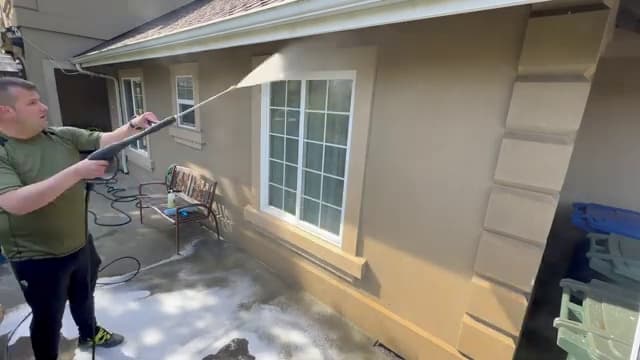
Low-pressure cleaning for vinyl, stucco, brick, fiber cement and painted wood, including soffit, fascia and gutter exteriors.
House washing in Jacksonville →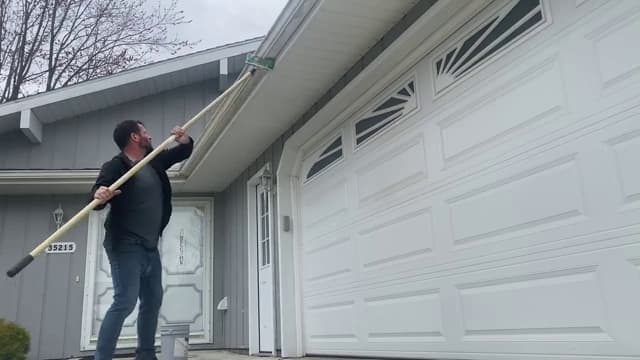
Two different jobs: clearing debris from inside the gutter, and removing the black striping from the outside.
Gutter cleaning →If you have a roof, building facade, multi-story exterior, or other hard-to-reach surface that needs cleaning, the first step is determining whether drone pressure washing is actually appropriate.
Tell us about the property, the surfaces that need cleaning, and the access challenge. Call (904) 938-8585 for an assessment and we can recommend the most appropriate cleaning approach.
Call Now